
Protein Molecular Weight Markers

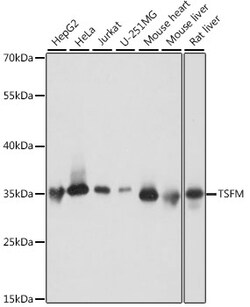
ABclonal Technology TSFM Rabbit pAb

This gene encodes a mitochondrial translation elongation factor. The encoded protein is an enzyme that catalyzes the exchange of guanine nucleotides on the translation elongation factor Tu during the elongation step of mitchondrial protein translation. Mutations in this gene are associated with combined oxidative phosphorylation deficiency-3 syndrome. Alternate splicing results in multiple transcript variants.

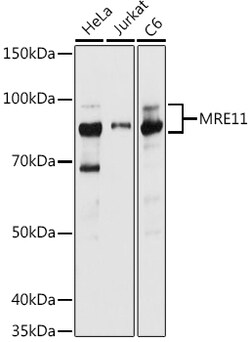
ABclonal Technology MRE11 Rabbit pAb
This gene encodes a nuclear protein involved in homologous recombination, telomere length maintenance, and DNA double-strand break repair. By itself, the protein has 3 to 5 exonuclease activity and endonuclease activity. The protein forms a complex with the RAD50 homolog, this complex is required for nonhomologous joining of DNA ends and possesses increased single-stranded DNA endonuclease and 3 to 5 exonuclease activities. In conjunction with a DNA ligase, this protein promotes the joining of noncomplementary ends in vitro using short homologies near the ends of the DNA fragments. This gene has a pseudogene on chromosome 3. Alternative splicing of this gene results in two transcript variants encoding different isoforms.
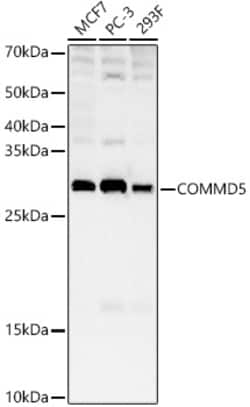
ABclonal Technology COMMD5 Rabbit pAb
Predicted to be involved in proximal tubule morphogenesis. Located in cytosol and nucleoplasm.
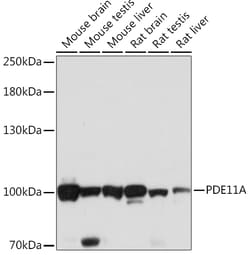
ABclonal Technology PDE11A Rabbit pAb
The 3,5-cyclic nucleotides cAMP and cGMP function as second messengers in a wide variety of signal transduction pathways. 3,5-cyclic nucleotide phosphodiesterases (PDEs) catalyze the hydrolysis of cAMP and cGMP to the corresponding 5-monophosphates and provide a mechanism to downregulate cAMP and cGMP signaling. This gene encodes a member of the PDE protein superfamily. Mutations in this gene are a cause of Cushing disease and adrenocortical hyperplasia. Multiple transcript variants encoding different isoforms have been found for this gene.
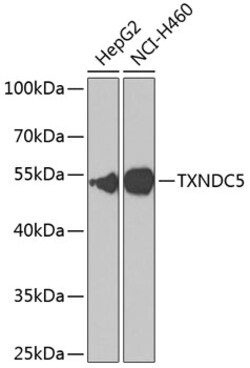
ABclonal Technology TXNDC5 Rabbit pAb
This gene encodes a member of the disulfide isomerase (PDI) family of endoplasmic reticulum (ER) proteins that catalyze protein folding and thiol-disulfide interchange reactions. The encoded protein has an N-terminal endoplasmic reticulum (ER)-signal sequence, three catalytically active thioredoxin domains and a C-terminal ER-retention sequence. Its expression is induced by hypoxia and its role may be to protect hypoxic cells from apoptosis. Alternative splicing results in multiple transcript variants. Read-through transcription also exists between this gene and the neighboring upstream BLOC1S5 gene.
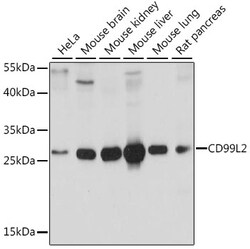
ABclonal Technology CD99L2 Rabbit pAb
This gene encodes a cell-surface protein that is similar to CD99. A similar protein in mouse functions as an adhesion molecule during leukocyte extravasation. Alternate splicing results in multiple transcript variants.
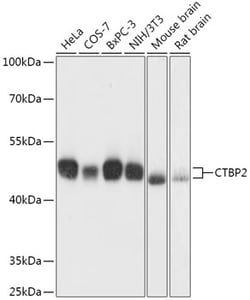
ABclonal Technology CTBP2 Rabbit pAb
This gene produces alternative transcripts encoding two distinct proteins. One protein is a transcriptional repressor, while the other isoform is a major component of specialized synapses known as synaptic ribbons. Both proteins contain a NAD+ binding domain similar to NAD+-dependent 2-hydroxyacid dehydrogenases. A portion of the 3 untranslated region was used to map this gene to chromosome 21q21.3, however, it was noted that similar loci elsewhere in the genome are likely. Blast analysis shows that this gene is present on chromosome 10. Several transcript variants encoding two different isoforms have been found for this gene.
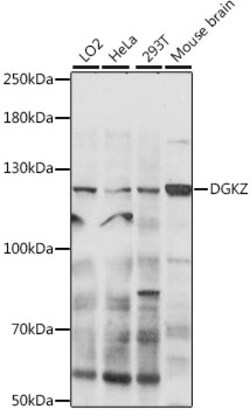
ABclonal Technology DGKZ Rabbit pAb
The protein encoded by this gene belongs to the eukaryotic diacylglycerol kinase family. It may attenuate protein kinase C activity by regulating diacylglycerol levels in intracellular signaling cascade and signal transduction. Alternative splicing occurs at this locus and multiple transcript variants encoding distinct isoforms have been identified.
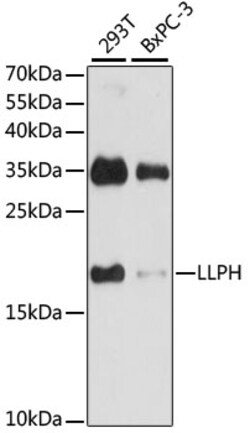
ABclonal Technology LLPH Rabbit pAb
Enables RNA binding activity. Predicted to be involved in dendrite extension and positive regulation of dendritic spine development. Located in chromosome and nucleolus.
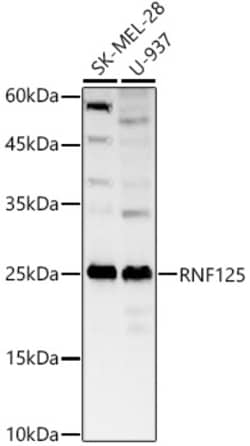
ABclonal Technology RNF125 Rabbit pAb
This gene encodes a novel E3 ubiquitin ligase that contains a RING finger domain in the N-terminus and three zinc-binding and one ubiquitin-interacting motif in the C-terminus. As a result of myristoylation, this protein associates with membranes and is primarily localized to intracellular membrane systems. The encoded protein may function as a positive regulator in the T-cell receptor signaling pathway.
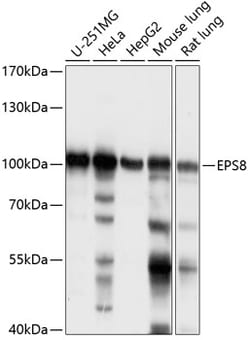
ABclonal Technology EPS8 Rabbit pAb
This gene encodes a member of the EPS8 family. This protein contains one PH domain and one SH3 domain. It functions as part of the EGFR pathway, though its exact role has not been determined. Highly similar proteins in other organisms are involved in the transduction of signals from Ras to Rac and growth factor-mediated actin remodeling. Alternate transcriptional splice variants of this gene have been observed but have not been thoroughly characterized.
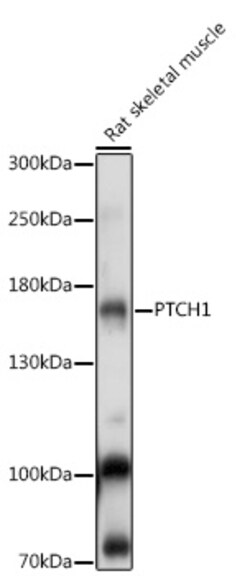
ABclonal Technology PTCH1 Rabbit pAb
This gene encodes a member of the patched family of proteins and a component of the hedgehog signaling pathway. Hedgehog signaling is important in embryonic development and tumorigenesis. The encoded protein is the receptor for the secreted hedgehog ligands, which include sonic hedgehog, indian hedgehog and desert hedgehog. Following binding by one of the hedgehog ligands, the encoded protein is trafficked away from the primary cilium, relieving inhibition of the G-protein-coupled receptor smoothened, which results in activation of downstream signaling. Mutations of this gene have been associated with basal cell nevus syndrome and holoprosencephaly.
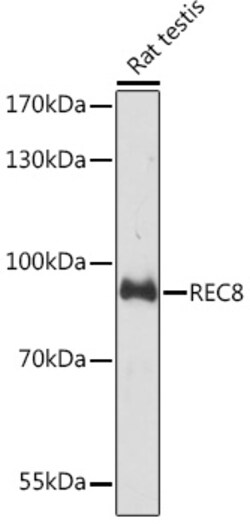
ABclonal Technology REC8 Rabbit pAb
Predicted to enable chromatin binding activity. Acts upstream of or within several processes, including gamete generation, seminiferous tubule development, and synaptonemal complex assembly. Located in kinetochore, lateral element, and male germ cell nucleus. Part of nuclear meiotic cohesin complex. Is expressed in several structures, including alimentary system, central nervous system, genitourinary system, respiratory system, and sensory organ. Orthologous to human REC8 (REC8 meiotic recombination protein).
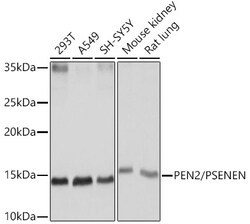
ABclonal Technology PEN2/PSENEN Rabbit mAb
Presenilins, which are components of the gamma-secretase protein complex, are required for intramembranous processing of some type I transmembrane proteins, such as the Notch proteins and the beta-amyloid precursor protein. Signaling by Notch receptors mediates a wide range of developmental cell fates. Processing of the beta-amyloid precursor protein generates neurotoxic amyloid beta peptides, the major component of senile plaques associated with Alzheimers disease. This gene encodes a protein that is required for Notch pathway signaling, and for the activity and accumulation of gamma-secretase. Mutations resulting in haploinsufficiency for this gene cause familial acne inversa-2 (ACNINV2). Alternative splicing results in multiple transcript variants.
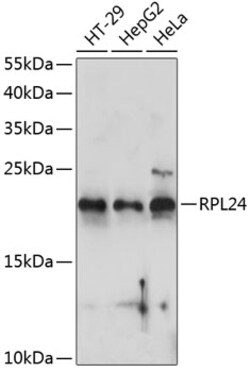
ABclonal Technology RPL24 Rabbit pAb
Ribosomes, the organelles that catalyze protein synthesis, consist of a small 40S subunit and a large 60S subunit. Together these subunits are composed of 4 RNA species and approximately 80 structurally distinct proteins. This gene encodes a ribosomal protein that is a component of the 60S subunit. The protein belongs to the L24E family of ribosomal proteins. It is located in the cytoplasm. This gene has been referred to as ribosomal protein L30 because the encoded protein shares amino acid identity with the L30 ribosomal proteins from S. cerevisiae, however, its official name is ribosomal protein L24. As is typical for genes encoding ribosomal proteins, there are multiple processed pseudogenes of this gene dispersed through the genome.